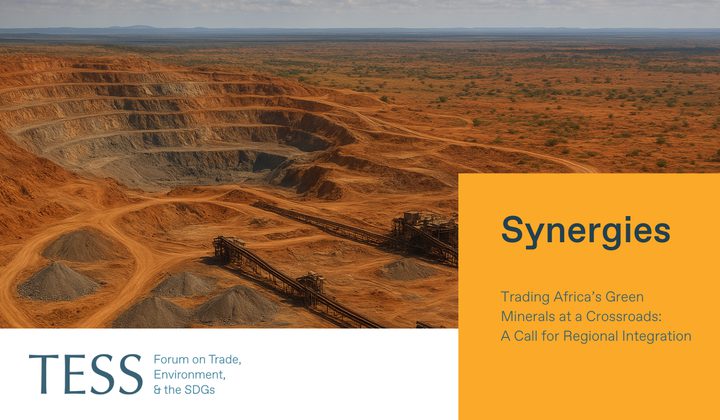
A global decarbonization agenda that is based on minerals extracted through an unjust development model cannot advance just global climate action and the African continent’s structural transformation. Trade, industrial, and climate cooperation must convert Africa’s mineral endowments into shared capabilities, regional value chains, and climate-resilient prosperity.

Marit Y. Kitaw
United Nations Economic Commission for Africa (UNECA)
Publication Date
18 September 2026
This article is part of a Synergies series on African trade and sustainability priorities and interests. Any views and opinions expressed are those of the author(s).
-----

Critical energy transition minerals are required for a transition to renewable energy storage systems. Lithium, cobalt, manganese, graphite, nickel, and manganese are needed for lithium-ion batteries, copper is necessary for grids and electrification, and electric vehicles and wind turbines require rare earth elements essential for permanent magnets.
The demand for these minerals for the energy transition is rapidly increasing. The IEA projects that, under net-zero pathways, demand for lithium could grow by eightfold and graphite fourfold by 2040. Under stated policies, cobalt and rare earths demand could rise by 50–60% by 2040, and copper by 30%.
For an energy transition to be considered just, the final technologies alone cannot be low carbon. Justice must extend across the entire value chain, from mineral extraction that considers human, social, and environmental rights, to mineral value addition and manufacturing that responds to the development and prosperity aspirations of the people where the extraction takes place; including the distribution of investment, technology, jobs, revenues, environmental risks, and decision-making power. Otherwise, the world risks replacing dependence on fossil fuels with a new pattern of mineral dependence that decarbonizes consumption in advanced economies while reproducing extraction, pollution, and low-value production in developing ones.
While Africa is well positioned to leverage its mineral endowment to move from extraction to structural economic transformation in this new energy transition paradigm, it still lacks the power to dictate its own terms on using its minerals to capture value by advancing in the value chains.
While policies and strategies such as the Africa Mining Vision (adopted in 2009) and the more recent African Green Minerals Strategy (launched in 2025) have recognized the paradox whereby mineral endowment co-exists side by side with poverty and have devised pathways to address it, the paradox persists where raw minerals are exported to enable an energy transition to other jurisdictions, while African citizens remain in poverty and lack basic access to energy. African countries also remain locked in narrow productive structures, with limited fiscal space and acute climate vulnerability.
The main question is how to link minerals effectively and coherently to trade, industrialization, infrastructure, technology, and skills development to transform African economies and improve people’s lives through coordinated, coherent policies.
This article argues that cooperative arrangements and partnerships that are win-win, fair, and just to all parties could be part of the answer. This would require treating supply security and structural transformation as reciprocal objectives, rather than resorting to agreements that secure African minerals while leaving technology, processing, manufacturing, and high-value services outside the continent.
The Missing Link: Intersectoral Coordination
When devising strategies for mineral-based industrialization, at least five sectors should work together for coherent, coordinated, and efficient policies and implementation. However, the five sectors—which include minerals, trade, energy, industry, and infrastructure—often evolve in silos, leading to suboptimal outcomes.
Indeed, while well-elaborated intersectoral coordination is key to meaningful impact, government entities often operate in isolation. For example, ministries in charge of mineral resources focus primarily on licensing, geological surveys, and production, while trade ministries negotiate tariffs and market access and deal with trade-related instruments such as rules of origin and export measures among others. Meanwhile, industry ministries concentrate on investment, industrial policy, local content, processing, refining, and manufacturing, whereas climate and energy ministries prepare nationally determined contributions, energy plans, and just transition strategies.
When mineral-based industrialization objectives are not formulated coherently by involving all of the related sectors, this will most likely lead to outcomes such as a processing and refining ambition without commensurate planning for reliable and renewable energy nor an assured market, a trade agreement without production capacity, or a climate strategy that treats minerals only as exports rather than foundations for domestic transformation. The lack of intersectoral coordination also weakens bargaining power in major negotiations. Developed and emerging countries increasingly combine mineral diplomacy with subsidies, strategic procurement, concessional finance, regulatory standards, and targeted trade arrangements.
The top three refining countries accounted for an average 86% of refined output for key energy minerals in 2024. China is projected to supply more than 60% of refined lithium and cobalt and around 80% of battery-grade graphite and rare earth elements used in magnets by 2035. Diversification is therefore a legitimate global objective, although this does not merely mean adding new mines in Africa to existing value chain destinations.
Africa’s offer is clear: investments that expand productive capacity on the continent with reliable, responsible, and increasingly low-carbon mineral value chains.
Africa’s offer is clear: investments that expand productive capacity on the continent with reliable, responsible, and increasingly low-carbon mineral value chains. It must be a win-win shared compact that requires policy coherence at the national level, at the regional scale under the African Continental Free Trade Area (AfCFTA) agreement, and in external partnerships, whose performance is measured against industrial, social, and climate outcomes.
From Comparative Advantage to Created Relative Advantage
Mineral endowment should be viewed as a means towards industrialization. Endowment alone is not an industrial strategy. The African Green Minerals Strategy is in essence an African mineral-based industrial strategy. The largest gains arise when countries build linkages around mining: backward linkages into engineering, equipment, chemicals, logistics, and professional services; forward linkages into refining, precursor materials, batteries, cables, alloys, and green technologies; and lateral linkages into renewable power, digital systems, research, and recycling.
The value difference can be substantial. A 2021 study by BloombergNEF found that the Democratic Republic of Congo (DRC) can leverage its cobalt and its hydroelectric power to become a cost- and emissions-competitive producer of battery cathode precursor materials. The study noted that the DRC could tap into a $271 billion battery precursor market by processing local cobalt into lithium-ion battery cathode precursors domestically, capturing significantly more economic value while cutting supply chain emissions compared to processing it in Poland, China, or the United States. By contrast, the DRC produces roughly 70% of the world's cobalt but captures only about 3% of the broader battery value chain. The DRC government has since decided to develop a battery value chain by focusing on battery precursors (i.e. nickel, manganese, and cobalt production).
In the same vein, UN Trade and Development reports that mineral processing significantly increased cobalt's unit value in the DRC. While the unit value of cobalt was approximately $5.80 per kilogramme at the point of extraction, it increased to $16.20 per kilogramme after processing. In 2022, the DRC exported approximately $6 billion in processed cobalt, compared with only $167 million in unprocessed cobalt. While processing is not full industrialization, it nevertheless demonstrates the importance of moving up the value chain to capture greater value.
It is also worth noting that effectiveness in capturing greater value along the chain would increase if African countries collaborated to share the hosting of specific value chain segments, depending on their relative comparative advantages.
Indeed, regional and country specialization could be are a more feasible pathway to achieve an integrated and viable industrial ecosystem. For example, one country may provide mineral feedstock, another renewable electricity and chemicals, another a deep water port or industrial park, and yet another a market for electric mobility or grid equipment. AfCFTA rules of origin and cumulation can turn these dispersed endowments, skills, standards, investment incentives, and public procurement procedures into an integrated framework for selected minerals and derived products rather than isolated mineral development.
The African Green Minerals Strategy offers a pathway from minerals for an energy transition to minerals for transformation.
The Africa Mining Vision and African Green Minerals Strategy advance that same logic of mineral-based industrialization. The latter calls for value addition at source, regional industrialization, responsible sourcing, technology and skills development, and climate-resilient mineral development. It offers a pathway from minerals for an energy transition to minerals for transformation. The next step is to translate this architecture into bankable cross-border projects, enforceable partnership commitments, and common positions in external negotiations.
Rewiring Cooperation: Five Tests for a Just Partnership
The proliferation of mineral partnerships, memoranda of understanding, and corridor initiatives creates an opening to reshape cooperation. Their quality should be judged by whether they shift where value is created and distribute transition benefits more fairly. Five tests should determine whether a partnership contributes to a just transition and shared transformation.
First, when agreeing to partner, it is essential to view the collaboration holistically across the entire value chain instead of bits and pieces of the chain to better identify where it can be leveraged to deliver the best outcome for all parties. For instance, it is crucial to link geological mapping, exploration, and extraction to energy, transport, and digital infrastructure, processing facilities, supplier development, research, recycling, and downstream demand. Instead of focusing exclusively on mining and exploration, partnerships with investors (whether foreign or national) or even public support should also cover long-term offtake, volume guarantees, contracts for difference, blended finance, and public procurement to help make first-of-a-kind African processing projects bankable. This matters because the IEA estimates that capital costs can be 50% higher in diversified locations than in incumbent producers.
Second, mineral-producing countries' aspirations for value addition and sustainability should not be limited by market restrictions but rather rewarded with market access. Agreements should be based on the principle that preferential access must be extended to African-processed materials and components, not only raw ores. Recognizing standards and frameworks developed by Africa (such as an African ESG framework currently being developed by UNECA) alongside conformity assessment systems, would reduce compliance costs and prevent “green” regulation from becoming another barrier to industrialization aspirations. Requirements related to traceability, transparency, and due diligence should be co-developed with African producers and should also reflect African ESG frameworks and compacts. These should be accompanied by finance, technology, and reasonable transition periods.
Third, while ideally there would be no need to sign contracts for individual mining projects—as they should simply abide by the law of the land—any contract or agreement should ensure that development policy space is preserved. This means that mineral-producing countries should use industrial policy measures and instruments judiciously through a calibrated toolkit of local content measures, performance requirements, strategic export measures, investment screening, public procurement, special economic zones, and time-bound incentives, among others. It is important to guarantee that these instruments are transparent, predictable, and supported by clear performance benchmarks. It would be unfair for international institutions to demand the removal of industrial instruments and measures by developing countries when developed countries are currently deploying their own large industrial subsidies. Instead, these institutions should assist developing countries to design these instruments and measures more efficiently.
Fourth, it is essential to insist on specific, explicit commitments on technology and skills, and not be limited to vague promises of “capacity building” or “technology transfer.” Partnerships and agreements must identify the specific technologies to be co-developed or licensed, the number and level of technicians, engineers, and other high-skilled jobs to be trained, the research institutions to be engaged, the intellectual property arrangements, and the milestones for local supplier participation under the local content requirements. African institutions should hold equity and knowledge, instead of simply providing unskilled labour.
Fifth, both benefits and risks must be shared fairly. The following criteria, among others, should be non-negotiable: transparent contracts that consider the benefits of all stakeholders; fair fiscal terms that do not reflect information asymmetries; community participation and meaningful engagement; employment that encourages women's inclusion and empowerment; protection of human rights at all levels; and mine closure obligations. An equitable and just partnership should account for the economic, environmental, and social costs, and identify the losers and winners in all aspects of the agreement. It is also important to understand who makes decisions, who participates in the decision-making process, and how affected communities, women, youth, and other stakeholders are engaged and can secure remedy.
The seven guiding principles and five actionable recommendations of the UN Secretary-General’s Panel on Critical Energy Transition Minerals provide a globally agreed foundation for such partnerships and arrangements.
Conclusion
The global decarbonization agenda implies that the world needs diversified, resilient, and responsible mineral value chains. Africa needs structural transformation, universal energy access, quality jobs, and climate resilience. While these objectives may appear competitive, they can mutually reinforce one another if their contours are properly designed. Africa should offer a partnership based on regional value chains, policy coherence, environmental integrity, technology co-development, and measurable benefit sharing.
Global mineral security must reinforce Africa’s industrial, energy, social, and climate security.
What is different is that Africa is no longer asking if it can fit into existing critical green mineral value chains but has shifted to asking how cooperation can build new and fairer ones. The African Green Minerals Strategy, AfCFTA, and Africa Mining Vision provide the policy foundation. The task now is to convert them into coordinated projects, negotiating principles, enforceable commitments, and financing arrangements.
Minerals for a just energy transition must become minerals for a just transformation. Global mineral security must reinforce Africa’s industrial, energy, social, and climate security. That is the cooperative bargain that can make the energy transition not only faster and more resilient, but genuinely just.
----------
Marit Y. Kitaw is Economic Affairs Officer, Minerals Sector Lead, Climate Change, Food Security, Natural Resources Division (CFND), United Nations Economic Commission for Africa (UNECA).
-----
Synergies is an online platform featuring expert commentary and opinions curated by TESS. We foster dialogue and incubate ideas on how to shape a global trading system that effectively addresses global environmental crises and advances sustainable development. Synergies draws on perspectives from leading experts and practitioners across policy communities from around the world. We cultivate solutions-oriented policy analysis for a sustainable future.
The Executive Editor is Fabrice Lehmann.
Disclaimer
Any views and opinions expressed in Synergies are those of the author(s) and do not necessarily reflect those of TESS or any of its partner organizations or funders.
License
All of the content on Synergies is licensed under a Creative Commons Attribution-NonCommercial-ShareAlike 4.0 International (CC BY-NC-SA 4.0) license. This means you are welcome to adapt, copy, and share it on your platforms with attribution to the source and author(s), but not for commercial purposes. You must also share it under the same CC BY-NC-SA 4.0 license.
If you would like to reuse any material published here or if you have any other question related to Synergies, send an email.
African Trade and Sustainability Priorities
This Synergies series aims to integrate and amplify perspectives from across the African continent in discussions on international trade and sustainability.