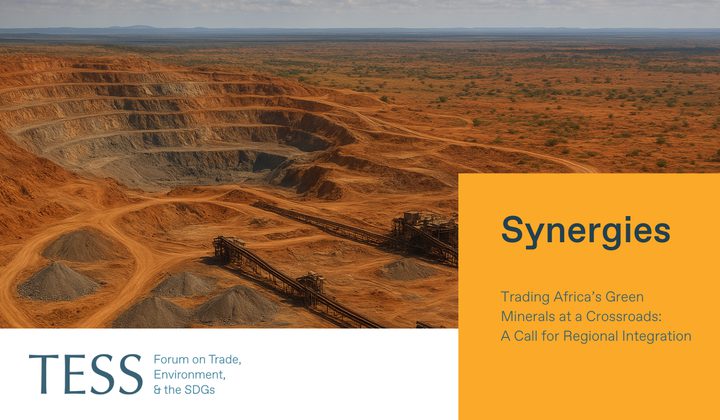
If African states fail to pay attention to addressing the structural challenges that are pivotal to their socio-economic development, harnessing the promises of critical minerals extraction and processing offers more of an illusion of industrialization. Without the accompanying coherent policy frameworks and urgent infrastructure investments, as well as a dogged implementation and willingness to correct errors in policy missteps, African countries will only consolidate their position as primary commodity suppliers.

Olabisi D. Akinkugbe
Schulich School of Law, Dalhousie University
Publication Date
29 July 2026
This article is part of a Synergies series on African trade and sustainability priorities and interests. Any views and opinions expressed are those of the author(s).
-----

There is an undeniable nexus between trade, sustainability, and critical minerals extraction in Africa. On the one hand, this nexus heralds some promises: a catalyst for industrialization, job creation, foreign investment, increased trade participation, and, potentially, an improved position in the global supply chain ladder for critical minerals. If well harnessed, these promises can be an important turning point for some African states’ long-standing but unwanted history as the centre of gravity of primary commodity supply to developed countries. On the other hand, given Africa’s structural inadequacies, the nexus could also deepen the continent’s economic, trade, and sustainability woes and reproduce underdevelopment if the necessary enabling environment that addresses these shortcomings remains absent.
In most African states, some essential basic conditions that are necessary to fully take advantage of the extraction of critical minerals are not in place. These include—but are not limited to—a lack of coherent policy for nurturing critical minerals industry growth, inadequate physical infrastructure, inconsistent power supply, fiscal barriers, and poor implementation regimes to safeguard against environmental pollution and discipline violators.
Accordingly, this article is guided by the following questions: To what extent can critical minerals extraction and processing in Africa trigger industrialization? For whom is the extraction of critical minerals critical? In what ways might critical minerals trade be critical for African states and investors who seek resilient supply and access? What strategies should African states adopt and implement urgently to avoid the resource curse?
The article’s central argument is that if African states fail to pay equal attention to addressing the structural challenges that are pivotal to their socio-economic development, harnessing the promises of critical minerals extraction and processing offers more of an illusion of industrialization.
To transition to realistic substantive gains from this illusion, African states must adopt a simultaneous process that addresses the asymmetric shortcomings of the international economic order that has sustained their underdevelopment and limited their capacity to trade beyond primary commodities. This would entail, inter alia, prioritizing critical legal and physical infrastructures, reducing incidences of illegal mining and illicit financial flows, creating enabling business environments, and effectively balancing environmental and socio-economic objectives.
Limits of Critical Minerals Extraction as Catalyst for Africa’s Industrialization
The extraction of critical minerals is premised on a dogged defence of their importance in transitioning to a low-emissions and digital future, and the possibility of greater value chain benefit for African states’ industrialization and sustainable development. Critical minerals are essential for the most advanced technologies and will only become more important as artificial intelligence, robotics, batteries, and autonomous devices transform our economies. Africa has a vast deposit of critical mineral resources. Yet, questions loom large on the plausibility of the benefits of critical minerals extraction for Africa and its peoples—particularly if economic relations premised on critical minerals do not go beyond extraction.
The criticality of raw minerals resonates differently for recourse-rich and resource-dependent countries.
Notably, the criticality of raw minerals resonates differently for recourse-rich and resource-dependent countries. Resource-dependent countries like the United States and European Union member states seek secure and resilient supply of critical minerals because they are involved in a geopolitical contest with China steeped in their economic and national security as well as their leadership in the emergent technology-driven industrial era. This race is taking place amid rising regional instabilities and a realignment of strategic partners. Chinese companies largely dominate the processing and refining capacities of critical minerals. Initiatives such as the EU Critical Raw Materials Act and the US Minerals Security Partnership and 2026 Critical Minerals Ministerial illustrate the different measures highly industrialized states are taking to secure access to resilient supply. Consequently, geopolitical fluidities, including trade wars, are redefining global minerals trade and add a new level of complexity to the plight of African countries.
In comparison, for resource-rich countries in Africa, critical minerals are explored with the promise of socio-economic development that transcends the resource curse. Yet, the dynamics of critical minerals extraction remain deeply entrenched in a historically inequitable international economic order. Further, trade partners and investors in resource-rich countries in Africa are confronted with an enormous set of national and international risks, including geopolitical tensions, exposure to price volatility, supply chain vulnerabilities, and environmental and social risks among others.
Often understated are the risks of significant environmental damage that accompany critical minerals extraction and production in resource-rich African countries, including land degradation, water stress, and pollution. Many critical minerals, such as lithium and copper, require water-intensive extraction and processing methods that exacerbate scarcity in arid regions. In addition, mining wastes, especially tailings, pose both a contamination and safety risk if mismanaged. Greenhouse gas emissions from mining and processing are also a growing concern, particularly as countries work to fulfil their climate commitments under the Paris Agreement.
Often understated are the risks of significant environmental damage that accompany critical minerals extraction and production in resource-rich African countries.
Put differently, mineral-based industrialization could become a justification for reproducing past practices if these resources are mined under weak oversight, as is common in many African countries. With many African resource-rich countries constrained by significant financial, technological, investment, skills, and infrastructure deficits to cascade beyond minerals extraction—along with incidences of illegal mining operations and the complicity of national elites—the landscape to truly grow the value chain and industrialize is skewed against them.
The reality therefore is that the quest for resilient critical minerals supply by powerful economies runs contrary to the industrialization aspirations of resource-rich economies in Africa. Put simply, the current critical minerals extraction paradigm in Africa reproduces the colonial economic logic. From this point of view, claims that critical minerals extraction and value addition will aid Africa’s industrialization miss the mark of the power relations and hierarchy that underpin international economic relations.
Capturing Higher Supply Chain Value for Industrialization: Modest Responses and Their Limits
Capturing higher value at different stages in critical minerals production is essential to the mandate of industrialization through extraction. This reality has eluded many resource-rich countries in Africa. To address the limited participation of African states in the higher value sectors of critical mineral supply chains, some African states have deployed policies aimed at overcoming this challenge. Countries such as Zimbabwe, Zambia, and Namibia, among others, have adopted industrial measures with the aim of prioritizing local value addition and advancing their role in critical mineral value chains beyond the mere export of raw materials by attracting long-term investors, encouraging skill and technology transfer, and supporting integration into global value chains. While these industrial policies are an important step, institutional bottlenecks remain a major impediment, even where measures are in place to require prospective foreign firms to refine minerals locally. Such actions must also avoid jeopardizing the interests of investors or exposing the state to the risk of investment arbitration.
The implications of these restrictive industrial and export policies for local processing of critical minerals by some African countries has so far been modest. The lessons from Zimbabwe and Namibia are that while increasing local processing, addressing the fiscal revenue gap and building regional integration would help recapture African mineral wealth. To benefit from the global demand for strategic minerals, African countries must learn from past experiences and build transparent processes, coherent policies and follow-up with swift implementation that advances stability and benefits ordinary citizens. Further, to develop local industries to process critical minerals into higher value products, Africa must develop the human resource skills that will drive industrialization and expand its own energy access.
Capturing higher value at different stages in critical minerals production is essential to the mandate of industrialization through extraction.
Past experiences of natural resource extraction in Africa have been highly disruptive and destabilizing rather than growth- and development-centered; often contributing to the resource curse. This instability, in turn, made investing in Africa less attractive to countries and companies committed to higher standards of transparency and mutually beneficial partnerships.
While Africa’s critical minerals sector is poised for a significant expansion, with investment in mining and infrastructure forecast to trend upwards, the fundamental question is how to harness these investments in resource-rich countries for industrialization and sustainable development? On current evidence, and barring a coordinated effort by African states to reverse the trajectory, the main beneficiaries will remain the investors from resource-dependent rich countries and large emerging economies like China. From this point of view, sadly, critical mineral extraction in Africa will continue to be about the unsatiable needs of foreign powers competing for steady supply chains in a race to secure national and economic security interests.
Conclusion
Restriction of exportation of critical minerals in their natural form is not a recipe for industrialization. Africa’s historical and continuing vulnerability in the international economic order is being deepened by the rush for critical minerals. This reality is often compounded by the complicity of African leaders in illegal mining and illicit financial flows. Transcending the trappings of colonial continuities, contemporarily manifested in the façade offered by the promise of industrialization in the exploration and extraction of critical minerals must be seen for what it is—an illusion.
Without the accompanying coherent policy frameworks and urgent infrastructure investments, as well as a dogged implementation and willingness to correct errors in policy missteps, African countries will only consolidate their position as primary commodity suppliers.
----------
Olabisi D. Akinkugbe is Associate Professor and Purdy Crawford Chair in Business Law, Schulich School of Law, Dalhousie University; and Allan Rock Visiting Professor of Law, Faculty of Law – Common Law Section, University of Ottawa. Co-Founder & Editor, www.afronomicslaw.org. Co-Editor-in-Chief, African Journal of International Economic Law.
-----
Synergies is an online platform featuring expert commentary and opinions curated by TESS. We foster dialogue and incubate ideas on how to shape a global trading system that effectively addresses global environmental crises and advances sustainable development. Synergies draws on perspectives from leading experts and practitioners across policy communities from around the world. We cultivate solutions-oriented policy analysis for a sustainable future.
The Executive Editor is Fabrice Lehmann.
Disclaimer
Any views and opinions expressed in Synergies are those of the author(s) and do not necessarily reflect those of TESS or any of its partner organizations or funders.
License
All of the content on Synergies is licensed under a Creative Commons Attribution-NonCommercial-ShareAlike 4.0 International (CC BY-NC-SA 4.0) license. This means you are welcome to adapt, copy, and share it on your platforms with attribution to the source and author(s), but not for commercial purposes. You must also share it under the same CC BY-NC-SA 4.0 license.
If you would like to reuse any material published here or if you have any other question related to Synergies, send an email to Fabrice Lehmann.
African Trade and Sustainability Priorities
This Synergies series aims to integrate and amplify perspectives from across the African continent in discussions on international trade and sustainability.