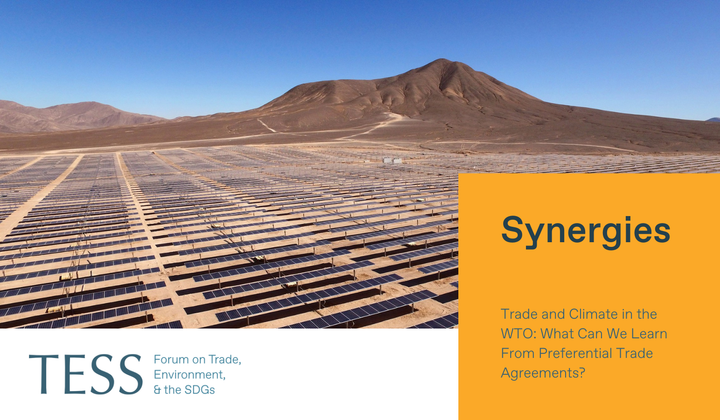
For African refinery transition strategies, a performance-conditioned transition instrument should be considered as a the better alternative to a generic subsidy, directing public support towards measurable transition outcomes, vulnerable groups, and future-compatible infrastructure.

Cecilia Wandiga
Centre for Science and Technology Innovations, Kenya
Publication Date
13 May 2026
This article is part of a Synergies series on African trade and sustainability priorities and interests. Any views and opinions expressed are those of the author(s) and do not necessarily reflect those of TESS or any of its partner organizations or funders.
-----

The current rules-based system of the WTO is fundamentally driven by consensus negotiations developed during earlier phases of globalization, often before the emergence of contemporary transition industries such as carbon dioxide removal, green hydrogen, advanced bio-based materials, digital MRV systems, and biodiversity-linked trade instruments. As a result, many emerging markets and industrializing economies entered global trade systems under frameworks largely shaped by historically dominant industrial powers with greater technical, legal, and negotiating capacity.
This asymmetry creates structural gaps between formal WTO agreements and the operational realities of global trade, enabling de facto practices that may contradict the spirit of multilateral agreements while remaining politically tolerated through informal “understood agreement” interpretations. Such practices frequently emerge under policy justifications linked to “national security,” “global systemic risk,” “strategic industrial policy,” or “balance of trade” concerns, particularly in sectors involving energy, semiconductors, food systems, and critical minerals.
Rebalancing the Rules of Trade
At the same time, the WTO framework remains primarily optimized around trade flows, tariffs, subsidies, and market access rather than ecological or public health externalities. While WTO agreements permit certain environmental and health-related measures under exceptions such as GATT Article XX, there are currently no universally adopted WTO trade metrics that systematically quantify biodiversity loss, toxicological exposure, ecosystem degradation, or long-term public health burdens within trade competitiveness calculations.
Consequently, countries attempting to integrate biodiversity protection, chemical safety, or ecological restoration into industrial policy often face uncertainty regarding whether such measures will be interpreted as legitimate environmental safeguards or disguised trade restrictions. This governance gap is becoming increasingly important as global markets shift away from traditional tariff competition towards carbon intensity, traceability systems, disclosure frameworks, and sustainability-linked procurement requirements.
Preferred Trading Incentives for Public Health and Biodiversity
Equally important within the global trading system is the political and economic value associated with achieving “preferred trading” relationships and trusted market-partner status under the WTO framework. Although the WTO does not formally designate a universal “preferred trader” category, enhanced market access arrangements, regulatory trust, and recognition of compliance capacity often function as informal indicators of above-average institutional performance, transparency, and adherence to multilateral trade rules.
In practice, countries and firms that demonstrate strong governance, traceability systems, standards compliance, and dispute-resolution credibility tend to experience lower transaction friction, improved investor confidence, and deeper integration into global value chains.
Under the WTO Agreement on Subsidies and Countervailing Measures, a subsidy exists when a government or public body provides a financial contribution, income support, or price support that confers a benefit on a firm, industry, or group of firms; the subsidy becomes actionable when it is specific and causes adverse effects to another member’s trade interests. In the fossil fuel context, WTO members increasingly distinguish between broad, untargeted support that lowers the cost of fossil fuels and transition-oriented measures that are temporary, transparent, targeted, and designed to reduce long-term environmental and fiscal harm.
Rather than relying primarily on broad subsidy-driven industrial competition, WTO reform discussions could increasingly focus on reducing non-tariff barriers that are informally justified under broad categories such as “national security,” “strategic autonomy,” or “systemic risk,” but which may function in practice as selective market-access restrictions or industrial protection mechanisms.
A more transparent and development-oriented alternative would be the establishment of a harmonized subsidy classification framework linked to technology readiness levels, infrastructure maturity, and production capacity equalization needs for emerging industries in developing economies. Under such an approach, temporary and performance-based support for early-stage technologies, industrial transition infrastructure, and ecological modernization could be differentiated from long-term market-distorting subsidies designed primarily to suppress competition.
African Renewable Energy Transitions and Trade Incentives
For African refinery transition strategies and other emerging industrial sectors, the better alternative is therefore not a generic subsidy, tax holiday, or cheap fuel support, but a performance-conditioned transition instrument tied to measurable outcomes such as methane monitoring, low-sulphur fuel standards, carbon-capture readiness, biodiversity safeguards, hydrogen retrofit capacity, public emissions disclosure, and circular petrochemical substitution pathways. Such an approach aligns more closely with subsidy reform guidance because it avoids permanently distorting fossil fuel prices while directing public support towards measurable transition outcomes, vulnerable groups, industrial upgrading, and future-compatible infrastructure.
In parallel, WTO members could explore expanding trade performance indicators beyond conventional measures of tariffs, export volumes, and industrial competitiveness by incorporating public health and biodiversity-related performance metrics into preferential trade recognition systems. Existing global frameworks such as the Kunming-Montreal Global Biodiversity Framework, Environmental Product Declarations, Health Product Declarations, and emerging sustainability disclosure systems already demonstrate that environmental and health performance can be standardized, measured, and integrated into procurement and investment decision-making.
Integrating such indicators into trade governance could help reduce the growing disconnect between economic competitiveness, ecological integrity, and long-term public health resilience while creating incentives for transition-ready industrial systems rather than purely low-cost production models.
----------
Cecilia Wandiga is Executive Director, Centre for Science and Technology Innovations, Kenya.
-----
Synergies is an online platform featuring expert commentary and opinions curated by TESS. We foster dialogue and incubate ideas on how to shape a global trading system that effectively addresses global environmental crises and advances sustainable development. Synergies draws on perspectives from leading experts and practitioners across policy communities from around the world. We cultivate solutions-oriented policy analysis for a sustainable future.
The Executive Editor is Fabrice Lehmann.
Disclaimer
Any views and opinions expressed in Synergies are those of the author(s) and do not necessarily reflect those of TESS or any of its partner organizations or funders.
License
All of the content on Synergies is licensed under a Creative Commons Attribution-NonCommercial-ShareAlike 4.0 International (CC BY-NC-SA 4.0) license. This means you are welcome to adapt, copy, and share it on your platforms with attribution to the source and author(s), but not for commercial purposes. You must also share it under the same CC BY-NC-SA 4.0 license.
If you would like to reuse any material published here or if you have any other question related to Synergies, send an email to Fabrice Lehmann.
African Trade and Sustainability Priorities
This Synergies series aims to integrate and amplify perspectives from across the African continent in discussions on international trade and sustainability.